

If your GP partner is pushing Business Central, don’t refuse the conversation and don’t sign yet. Ask what GP can’t do for your business, what a move would cost, and what waiting would cost.
TL;DR. A partner raising Business Central isn’t automatically wrong, and it isn’t automatically right either. Microsoft encourages the move, and it offers programs that support the partners who deliver it. Your job is to separate a real business reason from a sales calendar. Ask for a plain assessment of what GP does poorly for you, a scoped plan with phases, and a cost for waiting. Then pick your own decision date.
Picture the third call this year. Same partner, same pitch, same “have you thought about 2029?” You haven’t ignored it, you’ve just got a close to run, a payroll year-end coming, and a team that finally knows how GP works, and nobody wants to disrupt any of that for a project with no clear business reason. Familiar? If this sounds like your inbox, our Dynamics GP support and optimization team handles exactly this situation, and we’d rather help you think it through than push you anywhere.
Why your partner keeps bringing it up
Sometimes the reason is good. Sometimes it’s just the calendar.
Microsoft’s own GP documentation says “we are encouraging customers to transition to Dynamics 365 Business Central.” That’s Microsoft’s position, and partners hear it regularly. Microsoft also runs partner programs that help fund migrations. Its FY26 Business Central Migration Vouchers Program, which runs from July 1, 2026 to June 30, 2027, offers qualifying partners deployment services credits of up to $100,000 on deals above $25,000 in annual contract value, paid 30 percent at statement-of-work approval and 70 percent at proof of execution. The program page refers to on-premises Dynamics customers, and it doesn’t say whether GP deals qualify, so it’s worth confirming before you assume anything.
None of this means your partner is acting in bad faith. Many partners raise Business Central because they believe it’s the right fit. It simply helps to know these programs exist, so you can weigh the recommendation with the full picture in mind, the same way you’d weigh advice from any trusted vendor.
Stephen Tanner, our founder, has heard clients describe the feeling. “It seems like it’s more of a revenue thing for them.” He’s also fair about the other side. “It could be that they see something in your business process that GP is just not supporting very well at all, and Business Central, or some other system, might be so much better for you.”
Both can be true at once. Usually they are.
Don’t just say no
Your first instinct might be to shut the topic down. Stephen doesn’t think that’s always wise.
“I don’t know that you always have to push back and say, ‘No, I don’t want it, don’t even ask,'” he says. “Because there may be a point where there is a value in understanding, more readily, even though you might not be ready to do anything for a year or two.” He adds that “it may be worth looking at things with more of an open neutral perspective… I may not be ready to make a move yet, but maybe I need to be open to understanding what the move might look like for me.”
So hear them out. Then change the conversation. Think of a long-time supplier who suddenly wants you on a new product line. You wouldn’t say no on the spot, and you wouldn’t sign the first order either. You’d ask what problem it solves.
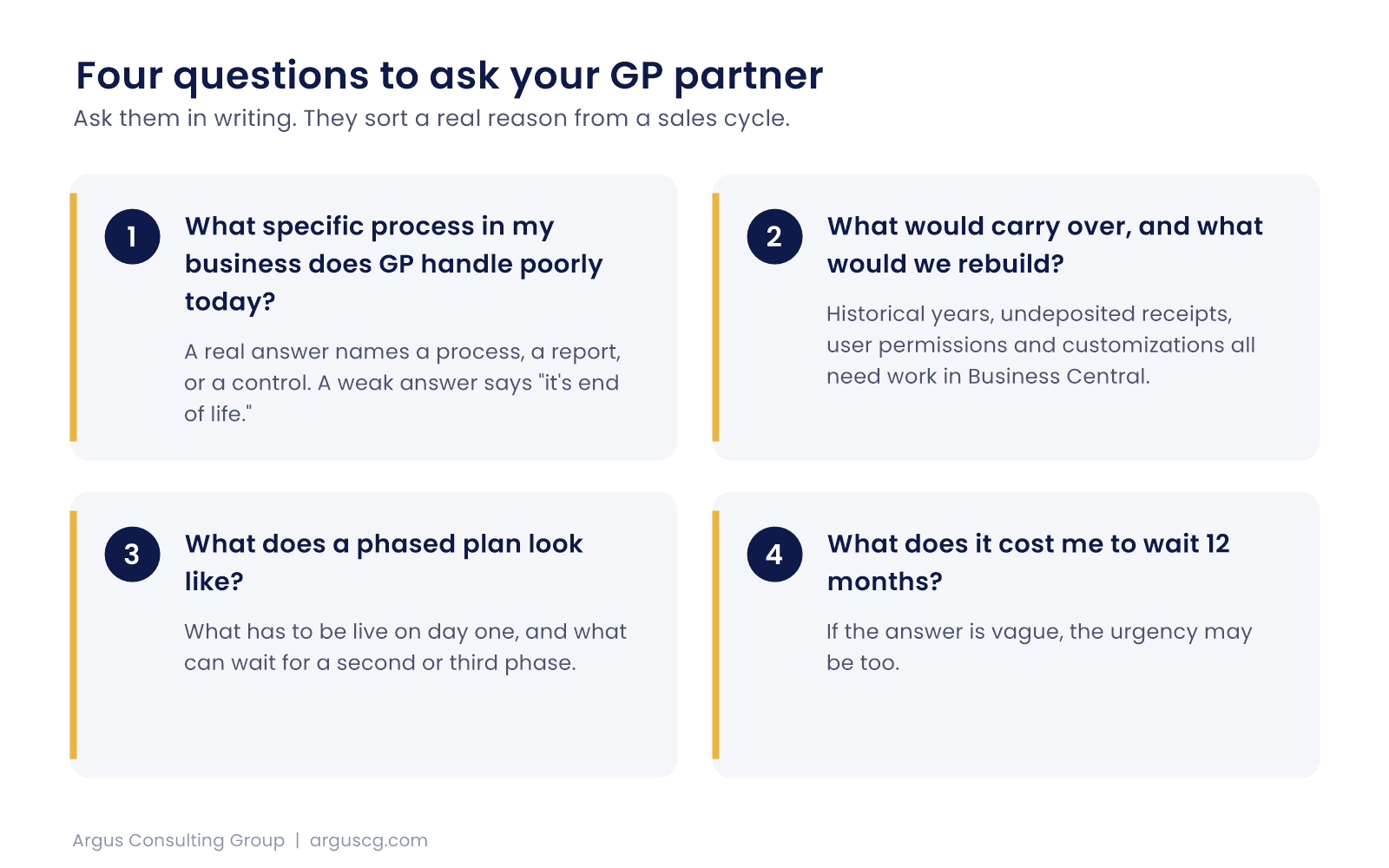
Four questions that sort a real reason from a sales cycle
Ask your partner these in writing.
What specific process in my business does GP handle poorly today? A real answer names a process, a report, or a control. A weak answer says “it’s end of life.”
What would carry over, and what would we rebuild? Microsoft’s migration documentation is blunt on this point. Years marked historical in GP arrive open and have to be closed in Business Central. Undeposited receipts don’t migrate. User permissions don’t carry over, and customizations must be converted to extensions.
What does a phased plan look like? A good partner can describe what has to be live on day one and what can wait for a second or third phase.
What does it cost me to wait 12 months? If the answer is vague, the urgency may be too.
Short questions. Hard to dodge.
Why “not ready” is a legitimate answer
Independent data says financial system projects don’t always go to plan. Panorama Consulting’s 2026 ERP Report surveyed 170 organizations between January 2025 and January 2026. More than a quarter said their project ran over budget, and almost a quarter ran over schedule. The most common reason for budget overruns was an unexpected need for additional technology, while the top reason for delays was organizational issues such as governance and resistance to change. Those respondents skew larger than most of our clients, with a median revenue of $200.5 million, so treat the numbers as directional.
The point isn’t that migrations fail. It’s that readiness is about people and process as much as software. Plenty of teams aren’t there yet. That’s not stubbornness. It’s accurate.
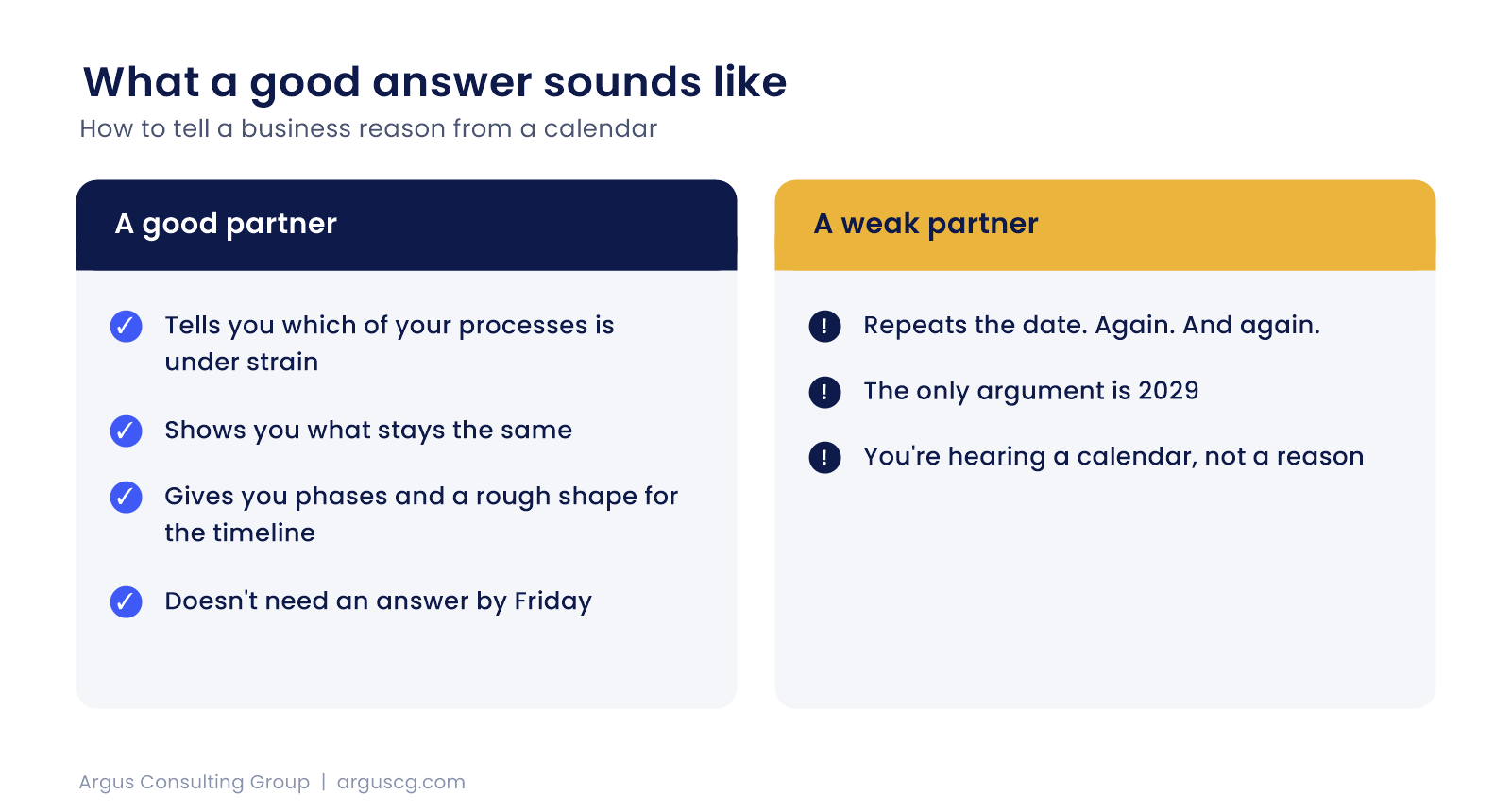
What a good answer sounds like
A good partner tells you which of your processes is under strain, shows you what stays the same, gives you phases and a rough shape for the timeline, and doesn’t need an answer by Friday.
A weak partner repeats the date. Again. And again. If the only argument is 2029, you’re hearing a calendar, not a reason.
Already holding a quote? Our post on what to check before you sign a Business Central quote walks through what’s included, what’s left out, and what to defer.
What the calendar really says
Microsoft’s GP support, including tax updates, ends December 31, 2029. Security updates run to April 30, 2031. That’s a boundary. It leaves room. Use it.
Argus has committed to supporting Dynamics GP through 2036, which we call the Argus 10-Year Commitment. We also handle GP to Business Central migrations in-house. Our revenue comes from both supporting GP and migrating, so no single answer is the one we need you to give. Your options are to stay, to optimize what you have, to host it in the cloud, or to migrate. Your timeline decides.
Questions about a partner pushing Business Central
Is it a red flag when my partner keeps raising Business Central?
Not by itself, because Microsoft encourages the move and a good partner should tell you about it. It becomes a red flag when the pitch has no business reason behind it, such as a named process GP handles poorly.
Do I have to migrate because Microsoft is ending GP support?
No date forces you to move, but Microsoft’s GP support, including tax updates, ends December 31, 2029, and security updates run to April 30, 2031. That gives you a planning window. What you do in it is a decision about your business, not a deadline you owe anyone.
How do I get a second opinion without insulting my current partner?
Treat it like any other vendor review, and ask for a neutral assessment of your current setup rather than a replacement quote. A professional partner won’t mind. If yours does, that’s useful information too.
Can I say no now and still revisit it later?
Yes, and it’s a reasonable position. Say you’re not ready, ask for a map of what a move would involve, and set a date to look again in a year or two. Understanding the shape of it now makes the later decision easier.
What if staying on GP is the right answer for us?
Then stay, and make sure the system is supported, hosted, and used well. In our experience, plenty of finance teams use a fraction of what GP can do. We’d start with an assessment that tells you honestly whether that’s you.
Want an opinion that isn’t a sales pitch?
Tell us what your partner is proposing and how GP is working for you today. We’ll give you an honest read on stay, optimize, or migrate. Start with a Free Business Assessment, or call (626) 403-9744.